The Ground Beneath Our Feet
This is not a prediction that millions of houses will suddenly become unsafe. Nor is it a reason to panic every time a small crack appears in a wall. It is, however, a timely reminder that the ground beneath our homes is changing, and understanding that ground is becoming increasingly important. The Ground Beneath Your House Matters More Than You Might Think. Most people judge a house by what they can see. The roof. The brickwork. The windows. The kitchen. Surveyors often begin somewhere else entirely. We start by asking a simple question. What is this building standing on? Every building relies on its foundations, but foundations themselves rely on the ground beneath them. If the ground remains stable, the building usually remains stable. If the ground moves, the building has little choice but to move with it. Think of a house as a passenger rather than the driver. The building does not decide to move. It simply responds to what is happening beneath its foundations. Understanding the soil is therefore just as important as understanding the building.
Not All Soils Behave the Same
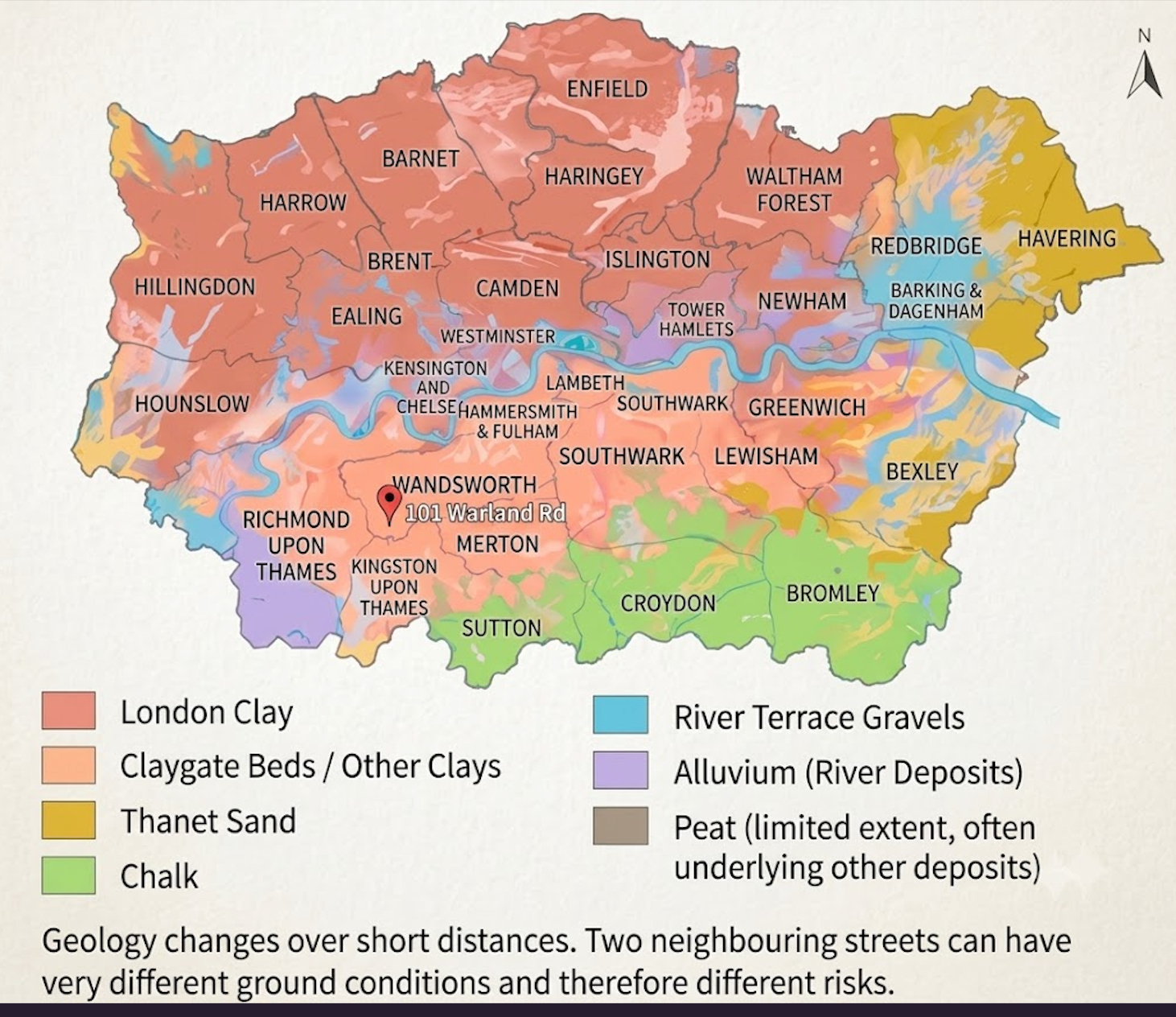
Britain’s geology is remarkably varied. Some houses are built on chalk. Others stand on gravel, sandstone or limestone. These materials generally change very little as the seasons change.

Clay is different. Clay behaves almost like a sponge. During wet weather, it absorbs moisture and expands.

During dry weather, it gradually loses moisture and contracts. This natural process is known as shrink-swell behaviour. In an average year, these seasonal changes are often so small that homeowners never notice them. Problems begin when exceptionally dry weather continues for several weeks or even months. As moisture is drawn from the clay, the soil gradually loses volume. If this shrinkage occurs evenly beneath an entire building, very little may happen. However, if one part of the foundations settles more than another, the building begins to twist slightly. Brickwork, plaster and other relatively brittle materials do not tolerate uneven movement particularly well. Small cracks may begin to appear, doors may start sticking, and windows may become more difficult to open. This is why surveyors are generally less interested in the crack itself than in the reason why it appeared. The crack is often only the symptom. The movement beneath the foundations is usually the cause.
Why Houses Do Not Suddenly Crack During a Heatwave
One of the biggest misconceptions surrounding subsidence is that a few very hot days can suddenly damage a house. That is rarely how it happens. The process usually develops gradually. Imagine a dry spring followed by several weeks of hot weather. Rainfall becomes scarce. Plants and trees continue extracting moisture from the ground. Evaporation increases. Week after week the clay slowly dries. As the moisture content falls, the clay contracts. The deeper the drying extends beneath the foundations, the greater the potential for movement. Many homeowners first notice something quite subtle. A door catches slightly on its frame. A window becomes stiff. A hairline crack reappears above a doorway where one had been repaired years before. Only after prolonged dry conditions do more obvious signs sometimes begin to develop. For this reason, subsidence claims often increase towards the end of summer or during early autumn rather than during the hottest day of the year. The ground needs time to dry before significant movement occurs.
Climate Change Is Changing the Odds
Climate change does not directly crack houses. It changes the conditions beneath them. Longer dry spells increase soil moisture deficits. More intense rainfall after drought causes repeated cycles of shrinking and swelling. Over many years, these cycles may become more pronounced than they were in previous decades. For most homes, this will not create serious structural problems. Many buildings have successfully accommodated small seasonal movements for more than a century. However, some properties are more vulnerable than others. Understanding why is one of the most important parts of assessing subsidence risk. In the next section, we will look at the factors that determine whether one house remains unaffected while another, only a few streets away, begins to develop structural movement. The answer often lies in the age of the property, the depth of its foundations, the surrounding vegetation and the history of the site itself.
Why the Age of Your Property Matters
One of the questions I am often asked is: “If my house has stood for over 100 years, why would it suddenly start moving now?” It is a sensible question. The answer lies in understanding how houses were built and how the environment around them has changed. Many of Britain’s Victorian, Edwardian and inter-war homes were constructed long before modern Building Regulations existed. Builders relied on the knowledge and standards of their time, which were often perfectly adequate for the conditions they expected the building to experience.
In many parts of the country, traditional brick houses were built on relatively shallow strip foundations. They have performed remarkably well, with many still providing safe, comfortable homes more than a century later. That does not mean they were designed for the climate we are beginning to experience today. Modern foundations are very different. Today’s Building Regulations require foundation depths to be selected according to the type of soil, the presence of nearby trees and the expected movement of the ground. Where shrinkable clay is present, foundations are often significantly deeper than those used in older properties. This does not mean every modern house is immune to subsidence, nor does it mean every Victorian house is vulnerable. It simply means that modern foundations are generally designed with a much greater understanding of how soils behave. Older houses have the advantage of experience. If they have stood successfully for over a hundred years, they have already demonstrated that they can tolerate a degree of seasonal movement. However, if the environmental conditions beneath them begin to change, they may experience movements they have never encountered before.
Every Building Has a Story
When I inspect a property, I rarely look at a crack in isolation. Instead, I try to understand the history of the building. How old is it? What type of foundations is it likely to have? What is the local geology? Have extensions been added? Are there mature trees nearby? Has the drainage system ever leaked? Has the surrounding ground level changed? Each of these questions helps explain why a building behaves the way it does. Two houses built in the same year can perform completely differently. One may stand on stable gravel with no nearby trees. The other may be built on shrinkable clay beside a mature oak tree with a leaking drain running beneath the front garden. Although they may appear identical from the outside, the forces acting beneath them are completely different. That is why surveyors spend as much time looking at the surroundings as they do at the building itself.
Trees Are Both Friends and Enemies
Trees make our towns and cities healthier places to live. They improve air quality, provide shade, reduce pollution and support wildlife. Unfortunately, some species also extract enormous quantities of water from the ground. During the growing season, mature trees continually draw moisture through their root systems. In many locations, this has little or no effect on nearby buildings. However, where shrinkable clay is present, prolonged moisture extraction can increase the amount of seasonal ground movement. The influence depends on many factors.
The species of tree. Its size. It's distance from the building. The local soil conditions. The weather. The depth of the foundations. This is why there is no simple rule stating that every tree causes subsidence. In fact, removing a mature tree without proper advice can sometimes create a different problem. Once the tree no longer extracts moisture, the clay may gradually rehydrate and expand. This can lead to upward ground movement, known as heave, which can be just as damaging as settlement. The correct solution is therefore not always to remove the tree. It is to understand how the tree, the soil and the building interact.

Water Can Be Just As Important As Heat
Most discussions about subsidence focus on drought. In reality, water is involved throughout the process. A leaking drain beneath a house may wash away fine particles or continuously soften the supporting soil. A burst water main may change moisture conditions beneath foundations. Poor surface drainage may repeatedly saturate certain areas while leaving others relatively dry. The result can be uneven support beneath the building. That is why a proper investigation rarely focuses on one possible cause. Experienced surveyors consider the whole picture. Weather. Trees. Ground conditions. Drainage. Building age. Foundation type. History of previous movement. These pieces of information gradually come together like a puzzle. Only then does the pattern begin to make sense.
Buildings Are More Flexible Than Most People Think
Many homeowners imagine their house as one solid block of brickwork. In reality, every building moves. Timber expands and contracts as its moisture content changes. Steel expands when heated. Concrete shrinks as it cures. Brickwork expands very slightly throughout its life. Even strong winds cause buildings to move by tiny amounts. Most of this movement is completely normal. The building has been designed to accommodate it. Subsidence becomes a concern only when movement becomes uneven, progressive or large enough to overstress parts of the structure. That is why finding a crack does not automatically mean there is a structural problem. Equally, ignoring progressive movement simply because “the house has always done that” can be equally unwise. The answer lies somewhere between those two extremes. The next section looks at how surveyors distinguish harmless movement from defects that require further investigation, and why accurate diagnosis is often far more valuable than immediate repair.
When Should You Be Concerned About Cracks?
One of the biggest myths surrounding subsidence is that every crack indicates a serious structural problem. Fortunately, that simply is not true. Every property develops small cracks during its lifetime. Plaster dries and shrinks. Timber moves slightly as humidity changes. Different building materials expand and contract at different rates. Even minor settlement during the early years of a building’s life can leave small hairline cracks that never change again. Most of these are perfectly normal. The challenge is recognising the difference between harmless movement and movement that deserves further investigation. As surveyors, we rarely judge a crack by its width alone. Instead, we ask a series of questions. Is it new? Has it changed recently? Does it become wider during dry summers and narrower after prolonged rainfall? Is it isolated, or are similar cracks appearing elsewhere? Does it continue through the brickwork, or is it confined to the plaster? Has the door beside it started sticking? Does the window still open properly? Has the floor become uneven? Only when these questions are considered together does the crack begin to tell its story.

Buildings Usually Give Warning Signs
One reason homeowners become anxious is that they imagine structural movement happens suddenly. In reality, buildings often provide a series of warning signs long before serious damage develops.
Perhaps the dining room door starts catching slightly. A small crack appears above the corner of a window. A kitchen cupboard no longer sits perfectly square. The conservatory doors become slightly harder to lock. None of these signs proves subsidence.
However, when several changes occur together, particularly following prolonged dry weather, they deserve closer attention. This is why surveyors never rely on a single observation. We look for patterns.
The Journey of a Crack
Imagine a traditional house built on clay soil. The spring is unusually dry.
Rainfall is well below average. By early summer, the trees are extracting increasing amounts of moisture from the ground. The clay beneath one corner of the house begins to shrink. Nothing appears to happen. A few weeks later, the front door catches slightly. The owner assumes the hinges need adjusting. By August, a fine diagonal crack appears above the living room window. It is only one millimetre wide. Easy to ignore. The following autumn, the weather becomes wetter. The clay slowly absorbs moisture again. The crack appears to stop growing. Perhaps it even closes slightly. The following summer, another prolonged dry spell arrives. The same crack reappears. This time it opens a little wider. The process repeats over several years. This is how many cases of subsidence develop. Not overnight. Not after one hot afternoon. But gradually, through repeated cycles of drying and rehydration.
Why Monitoring Is Often Better Than Guessing
One of the most valuable tools available to surveyors is time. A single inspection provides a snapshot. Monitoring tells the story. If movement is suspected, it is often far more useful to record the condition carefully than to rush into expensive repairs. Photographs taken from the same position. Measurements of crack widths. Simple tell-tales. Repeat inspections. Together, they help establish whether movement is historic, seasonal or progressive. This information is often far more valuable than immediately deciding that underpinning is required. In fact, many cracks that initially concern homeowners prove to be long-standing, stable defects requiring little more than routine maintenance.
Modern Engineering Has Come a Long Way
The word “subsidence” often conjures images of demolished houses and enormous repair bills. Fortunately, engineering has advanced considerably. The first step is always identifying the cause. If leaking drains are responsible, repairing the drainage may solve the problem. If trees are contributing, careful arboricultural advice may be appropriate. If the issue relates to poor ground support, engineers now have a range of proven techniques available. Depending on the circumstances, these may include resin injection, pressure grouting, mini-piles, traditional underpinning or other specialist foundation solutions. Every property is different. There is no universal repair. The correct solution depends entirely upon the cause of the movement. This is another reason why obtaining an accurate diagnosis is so important. Treating the symptoms without understanding the underlying problem rarely produces the best long-term outcome.
Do Not Underestimate the Importance of Insurance
For most people, their home is their largest financial investment. Yet many homeowners only discover the details of their buildings insurance when something goes wrong. Subsidence investigations can involve specialist surveys, drainage inspections, monitoring, arboricultural advice and structural engineering input before repairs even begin. Where significant movement is confirmed, repair costs can become substantial. Appropriate buildings insurance provides an important level of financial protection against these unexpected events. Policies vary considerably, particularly regarding excesses and conditions relating to subsidence claims, so it is worth reviewing your cover before a problem arises rather than afterwards. Good insurance cannot prevent movement. It can, however, make dealing with it considerably less stressful.
The Value of Independent Advice
During my inspections, I regularly meet homeowners who have spent weeks searching the internet, comparing photographs and reading conflicting opinions. Some convince themselves that the house is about to collapse. Others persuade themselves that there is nothing to worry about. Neither approach is particularly helpful. Buildings are individual. The same crack can have very different causes depending on the age of the property, its construction, its foundations and the ground beneath it. An experienced surveyor does not simply measure a crack. They interpret it. They look beyond the visible defect and consider the building as a whole. That is often the difference between treating a symptom and understanding the real cause. Recognising how difficult it can be for homeowners to distinguish between harmless cracking and movement that genuinely deserves investigation was one of the reasons I wrote Cracks in Residential Buildings – A Visual Guide to Structural Movement and Common Defects. The book uses photographs from real inspections to explain the most common crack patterns in plain language. Alongside it, the Crack Guide app provides a quick visual reference to help homeowners understand what they are seeing. Neither replaces a professional inspection, but both were created to help people make informed decisions before unnecessary worry turns into unnecessary expense. In the final section, we’ll look ahead at what climate change is likely to mean for Britain’s housing stock over the coming decades, and finish with five practical steps every homeowner can take to protect their property.
Looking Ahead
No one can predict exactly how Britain’s climate will evolve over the next fifty years. What we do know is that the scientific evidence increasingly points towards hotter summers, longer dry periods and more frequent extremes of weather. That is why organisations such as the British Geological Survey are investing considerable effort in understanding how climate change may affect the ground beneath our homes. Their work is not intended to create unnecessary alarm. It is designed to help engineers, planners, insurers and homeowners prepare for changes that may gradually become more common over the coming decades. For many people, nothing will change. Millions of homes built on clay soils have stood successfully for generations and will continue to do so. Others may experience slightly greater seasonal movement than they have in the past. A smaller number may develop defects that require investigation or repair. The important point is that climate change is changing the probability of movement, not guaranteeing it. Every property is different. The local geology, the depth of the foundations, nearby trees, drainage, groundwater conditions, previous alterations and even neighbouring buildings all influence how a house behaves. There is no single rule that applies to every property. That is why professional assessment remains so important.
The Future Is Not All Bad News
When people hear the word “subsidence”, they often imagine a house beyond repair. That image is rarely accurate. Modern surveying techniques allow movement to be measured far more accurately than ever before. Specialist cameras, crack monitoring, laser measurements, drone inspections and digital records enable surveyors and engineers to identify subtle changes long before serious structural damage develops. Engineering solutions have also advanced significantly. Many cases can be resolved by addressing the underlying cause rather than carrying out major structural works. Improving drainage. Managing vegetation. Repairing leaking underground services. Stabilising the ground. Where more extensive work is required, techniques such as resin injection, pressure grouting, mini-piles and underpinning provide well-established engineering solutions. The important point is that subsidence is one of the best understood structural issues affecting residential buildings. It is not a mystery. It is not untreatable. It simply requires the correct diagnosis.
Five Things Every Homeowner Should Remember
If you remember nothing else from this guide, remember these five points. First, climate change does not directly crack houses. It changes the way the ground behaves beneath them. Second, not every crack is a sign of subsidence. Most cracks found in residential properties are caused by normal building movement, drying, thermal expansion or minor settlement. Third, older houses often have shallower foundations than modern homes. That does not make them poorly built. Many have successfully stood for more than a century. However, they may be less tolerant of changing ground conditions than buildings designed to current standards. Fourth, good buildings insurance is one of the most valuable forms of protection a homeowner can have. Understanding your policy before a problem develops is far preferable to discovering its limitations afterwards. Finally, if you are concerned about movement, seek independent professional advice before making assumptions or committing to expensive repairs. Correct diagnosis should always come before corrective action.
A Final Thought
After surveying hundreds of residential properties, I have learned that buildings rarely surprise us without warning. They usually tell a story. A door begins sticking. A window becomes difficult to open. A small crack appears above a window. Another follows beside a doorway. Individually, these changes may mean very little. Together, they begin to paint a picture. The role of an experienced surveyor is not simply to identify defects. It is to understand that story, separate normal building behaviour from genuine structural concerns and provide clear, practical advice based on evidence rather than assumption. Climate change means that understanding our homes will become increasingly important. Fortunately, understanding is something we can all improve. That is one of the reasons I wrote Cracks in Residential Buildings – A Visual Guide to Structural Movement and Common Defects. My aim was to explain structural movement using real inspection photographs and straightforward language rather than technical jargon. The accompanying Crack Guide app was developed for the same reason, giving homeowners and property professionals a quick visual reference to common crack patterns and helping them decide when further investigation may be appropriate. Neither resource replaces a professional inspection. They are intended to help people ask better questions, understand their buildings more confidently and make informed decisions based on knowledge rather than uncertainty. Our homes are usually the largest investment we will ever make. Looking after them begins with understanding how they work. The bricks and mortar above ground may be what we see every day. But it is the ground beneath our feet that quietly supports everything above it.